




We fell so behind on today’s comic, it was right down to the line! Matt had to color 4 pages all on Monday, so he decided to do a Youtube live stream of it! So go check that out if you’re at all interested in seeing how the cake is made. In the first few hours he takes time to write and show his thoughts as he works; super interesting, even for me! We’re hoping to do more of these in the future.
This week we review ‘Queer: A Graphic History’ and ooooooh dang I cannot recommend it enough. Super valuable information in here that is absolutely required reading.
Buy it from one of our Friends (With Benefits)
↓ Comic Transcript
Queer: A Graphic History, a review by Erika Moen, published on https://www.ohjoysextoy.com/queer-book on November 29, 2016
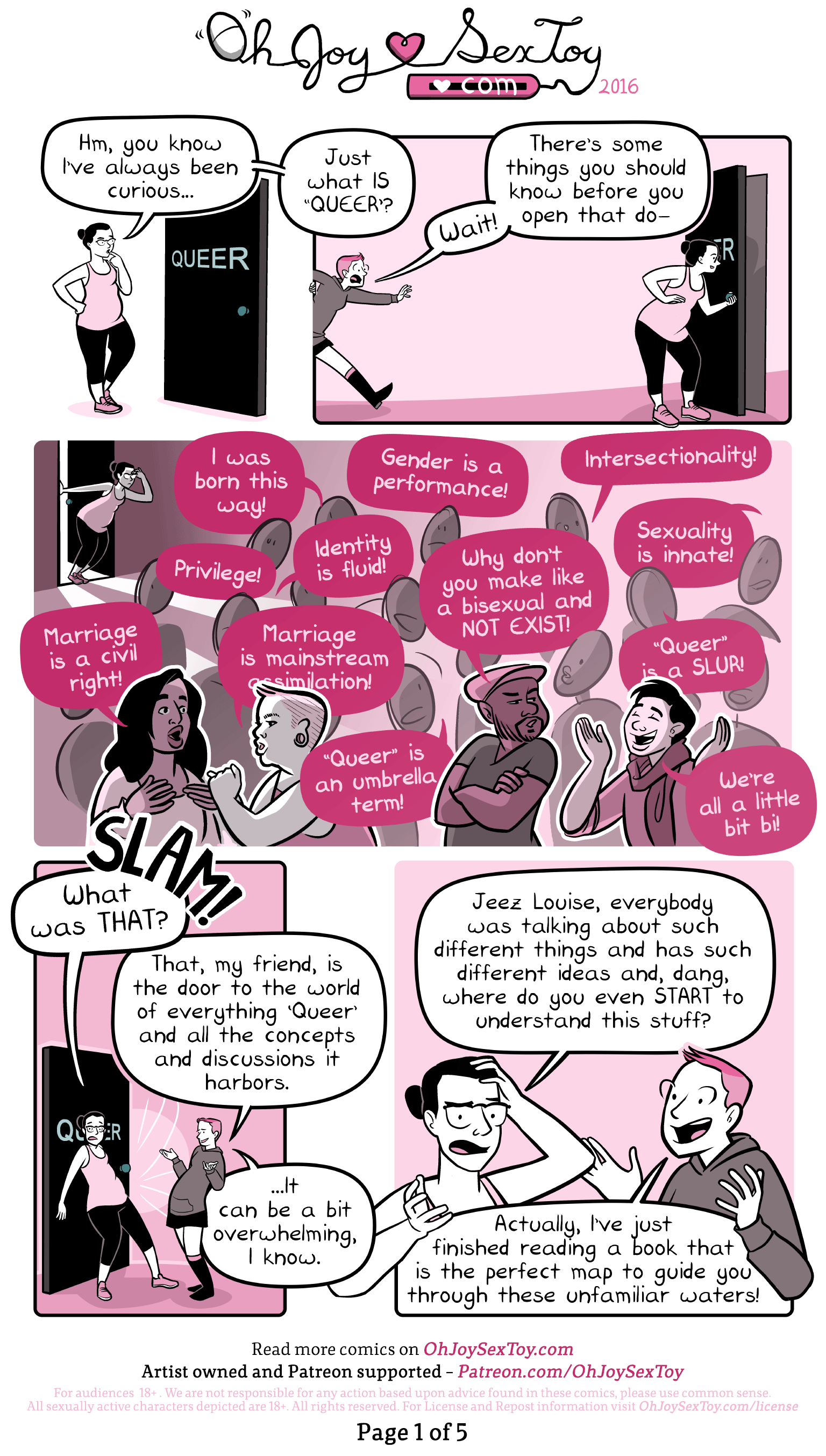
Erika draws in a soft, cartoon-y style with a pink palette. Samples of Julia Scheele's artwork appear throughout the comic as well, which are also cartoony but much more angular.
Alex wears glasses, a tank top and black leggings and stands outside a big black door labeled "QUEER". Their black hair is pulled back into a bun.
"Hm, you know I've always been curious..." Alex muses to themself. "Just what IS 'QUEER'?"
Just as they begin to crack the door, Erika bursts in from the side of the panel, shouting, "Wait! There's some things you should know before you open that do-"
Too late! Alex leans in to the room on the other side of the door, anchored only be their one hand on the doorway. They hold their free hand up to their eyes, to get a better look at the bedlam unfurling before them. It is a room packed with people all talking passionately and even arguing. Snippets of their conversations overlap, including:
"I was born this way!"
"Privilege!"
"Marriage is a civil right!"
"Gender is a performance!"
"Identity is fluid!"
"Marriage is a mainstream assimilation!"
"'Queer' is an umbrella term!"
"Why don't you make like a bisexual and NOT EXIST!"
"Intersectionality!"
"Sexuality is innate!"
"'Queer' is a SLUR!"
"We're all a little bit bi!"
Alex wheels back to the other side of the door, slamming it closed. "What was THAT?" They ask in shock as they slump against the door to keep it from re-opening.
"That, my friend, is the door to the world of everything "Queer" and all the concepts and discussions it harbors." Erika explains jovially. "...It can be a little overwhelming, I know." Erika is a white cis woman with short pink hair who wears a long hoody, black skirt, and tall black boots.
"Jeez Louise, everybody was talking about such different things and has such different ideas and, dang, where do you even START to understand this stuff?" Alex asks in confused frustration.
"Actually," Erika enthuses. "I've just finished reading a book that is the perfect map to guide you through these unfamiliar waters!"
Page 2
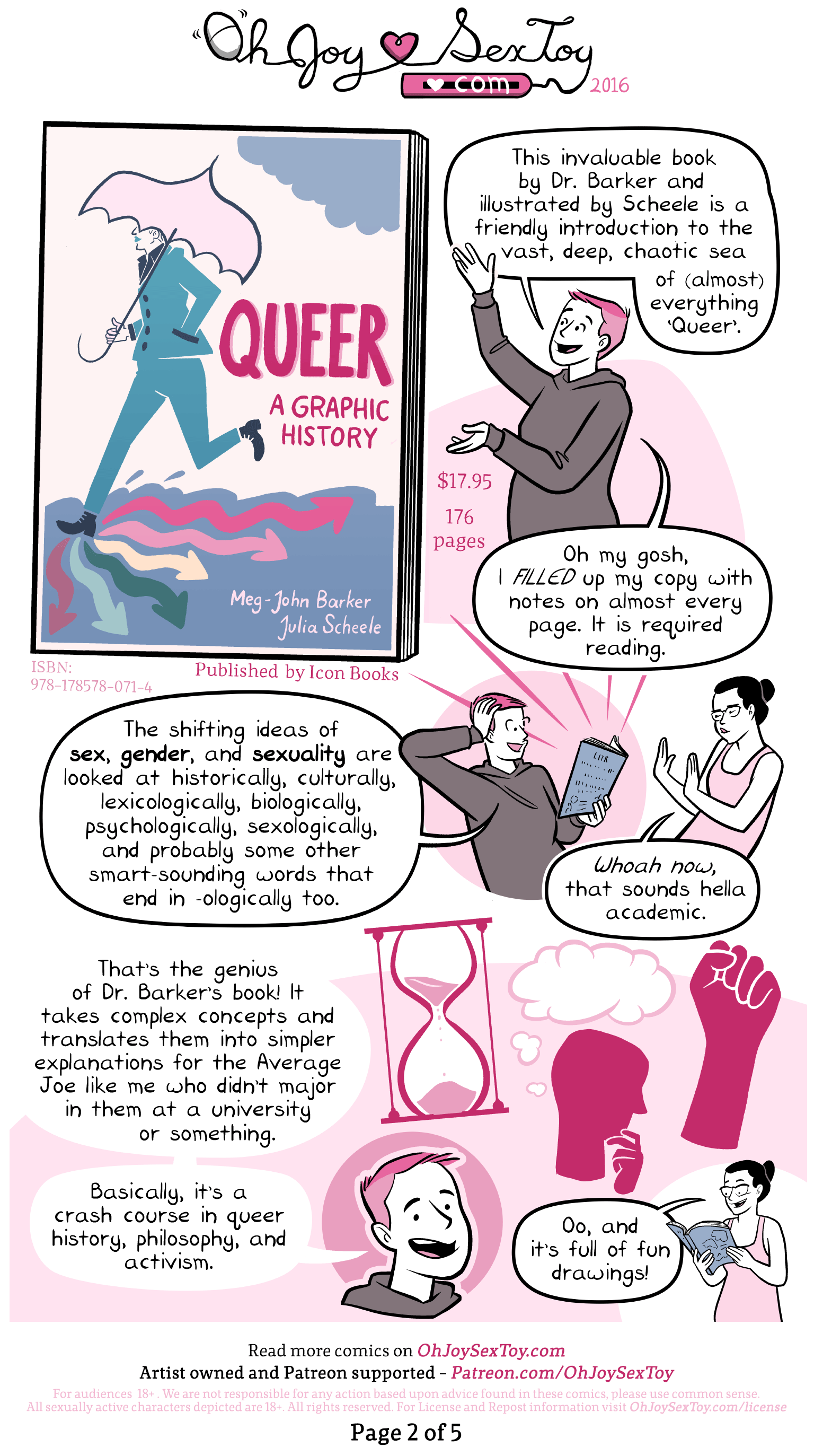
A giant copy of the book "QUEER: A Graphic History by Meg-John Barker and Julia Scheele. Published by Icon Books." appears next to Erika, who gestures at it, saying, "This invaluable book by Dr. Barker and illustrated by Scheele is a friendly introduction to the vast, deep, chaotic sea of (almost) everything 'Queer'. Ohmy gosh, I FILLED up my copy with notes on almost every page. It is required reading."
Information floats by the book, adding, "$17.95, 176 pages"
Reading from her own normal-sized copy of the book, Erika goes on, "The shifting ideas of sex, gender, and sexuality are looked at historically, culturally, lexicologically, biologically, psychologically, sexologically, and probably some other smart-sounding words that end in -ologically too."
Holding up their hands while taking a step back, Alex replies cautiously, "Whoah now, that sounds hella academic."
"That's the genius of Dr. Barker's book!" Erika continues. "It takes complex concepts and translates them into simpler explanations for the Average Joe like me who didn't major in them at a university or something. Basically, it's a crash course in queer history, philosophy, and activism."
Icons float overhead showing an hourglass (for history), the head silhouette of a person stroking their chin pensively with a thought balloon emanating above them (for philosophy), and the silhouette of a raised fist (for activism).
"Oo, and it's full of fun drawings!" Realizes Alex as they flip through the pages.
Page 3
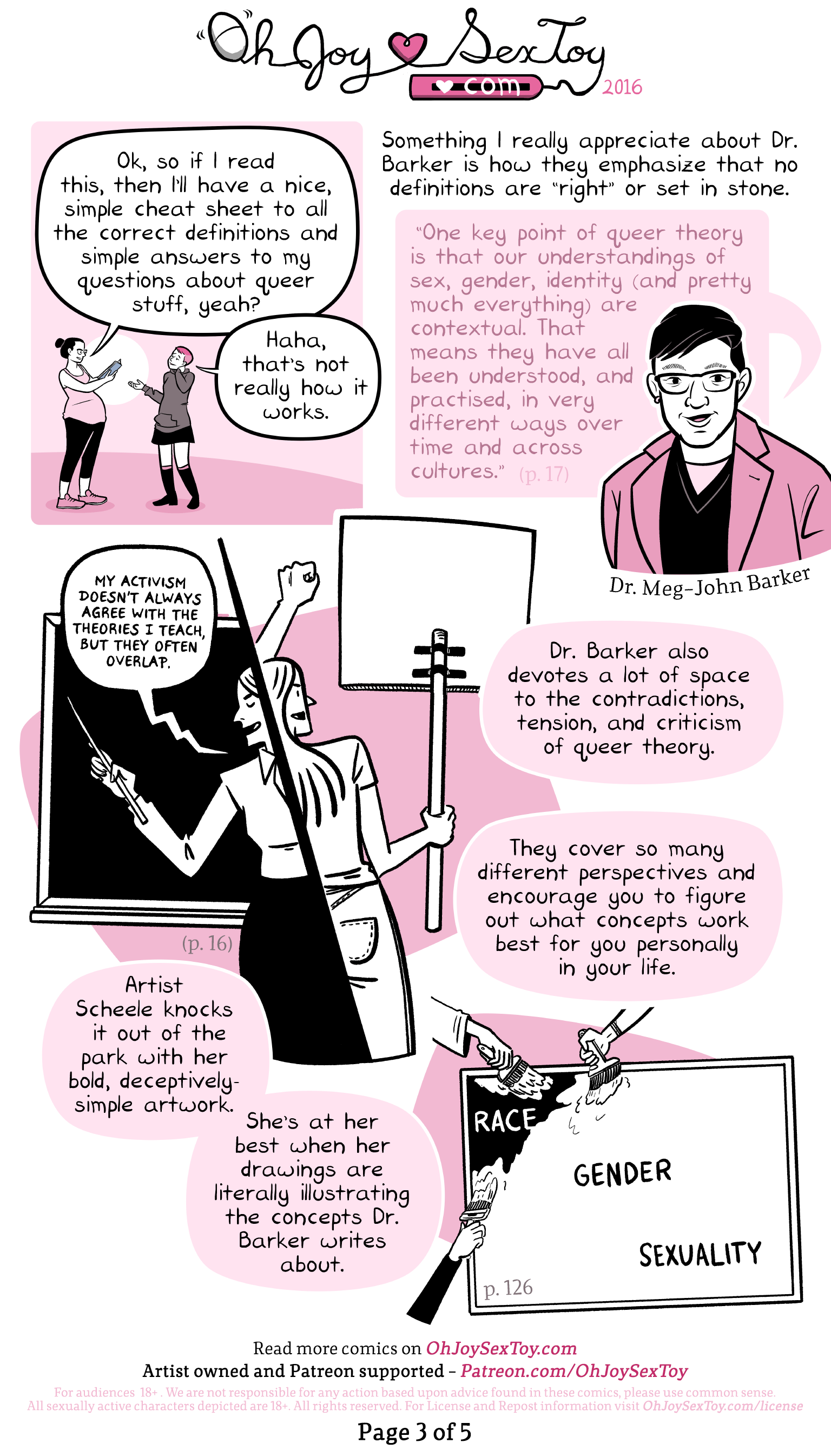
"Ok, so if I read this, then I'll have a nice, simple cheat sheet to all the correct definitions and simple answers to my questions about queer stuff, yeah?" Asks Alex, holding up the book.
"Haha, that's not really how it works." Erika explains.
Narration: Something I really appreciate about Dr. Barker is how they emphasize that no definitions are "right" or set in stone.
A more realistic portrait of Dr. Meg-John Barker appears, showing them with a short crop of black hair, glasses, and a coat over their top shirt layers. They explain, "One key point of queer theory is that our understandings of sex, gender, identity (and pretty much everything) are contextual. That means they have all been understood, and practiced, in very different ways over time and across cultures." (p. 17)
Narration: Dr. Barker also devotes a lot of space to the contradictions, tension, and criticism of queer theory. They cover so many different perspectives and encourage you to figure out what concepts work best for you personally in your life.
A sample of Scheele's artwork is on display. It shows a person on either side of a diagonal line, representing their dual experiences. On the left side, they gesture at a blackboard with a pointer and are dressed professionally in a collared blouse with a long black skirt. This version of that person says, "My activism doesn't always agree with the theories I teach, but they often overlap." On the other side of the diagonal line, the same person is now dressed casually in jeans and t-shirt, holding up a picket sign with their other fist in the air.
Narration: Artist Scheele knocks it out of the park with her bold, deceptively-simple artwork. She's at her best when her drawings are literally illustrating the concepts Dr. Barker writes about.
Another Scheele illustration shows a black chalkboard with the words "RACE", "GENDER", and "SEXUALITY" written diagonally down it, while three hands paint over the black surface with broad white paintbrushes. "GENDER" and "SEXUALITY" sit on the section of the board that has been painted white, while "RACE" sits in the top left corner of what is still the blackboard, but is quickly being approached by the white paintbrushes.
Page 4
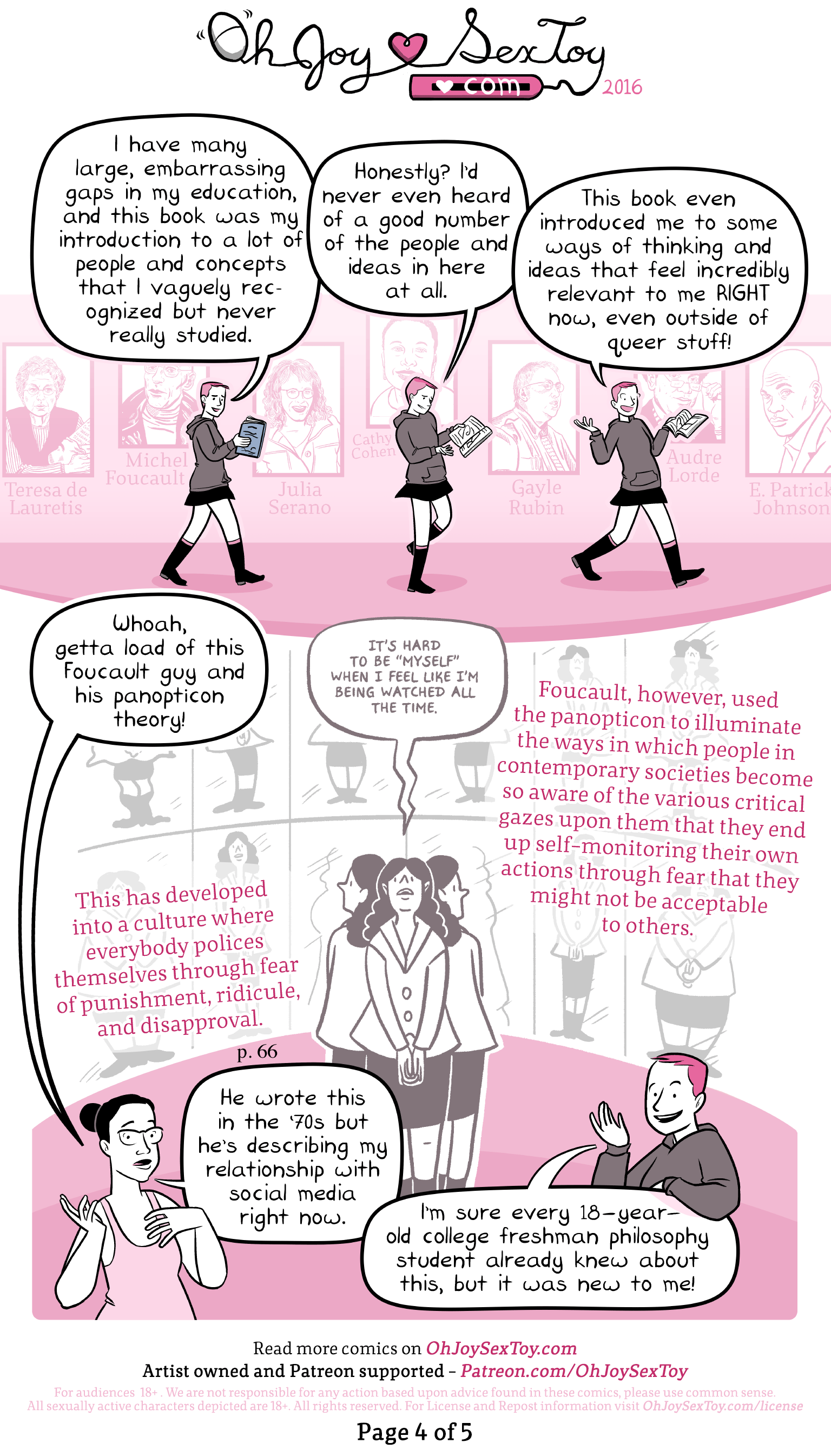
Erika walks down a hall of portraits, which are illustrated by Scheele. They include: Teresa de Lauretis, Michel Foucault, Julia Serano, Cathy Cohen, Gayle Rubin, Audre Lorde, E. Patrick Johnson.
She talks while gesturing with her copy of the book, "I have many large, embarrassing gaps in my education, and this book was my introduction to a lot of people and concepts that I vaguely recognized but never really studied. Honestly? I'd never even heard of a good number of the people and ideas in here at all. This book even introduced me to some ways of thinking and ideas that feel incredibly relevant to me RIGHT now, even outside of queer stuff!"
"Whoah, getta load of this Foucault guy and his panopticon theory!" Exclaims Alex in front of an excerpt from the book. It features another illustration by Scheele, showing three people standing back-to-back inside a rounded room of mirrors, each reflecting the person with some distortion. The person announces, "It's hard to be 'myself' when I feel like I'm being watched all the time." Overlaid across the illustration is an excerpt of text by Barker, reading, "Foucault, however, used the panopticon to illuminate the ways in which people in contemporary societies become so aware of the various critical gazes upon them that they end up self-monitoring their own actions through fear that they might not be acceptable to others. This has developed into a culture where everybody polices themselves through fear of punishment, ridicule, and disapproval." (p. 66)
Alex continues, "He wrote this in the '70s but he's describing me relationship with social media right now."
"I'm sure every 18-year-old college freshman philosophy student already knew about this, but it was new to me!" Chirps Erika, unashamed at her ignorance.
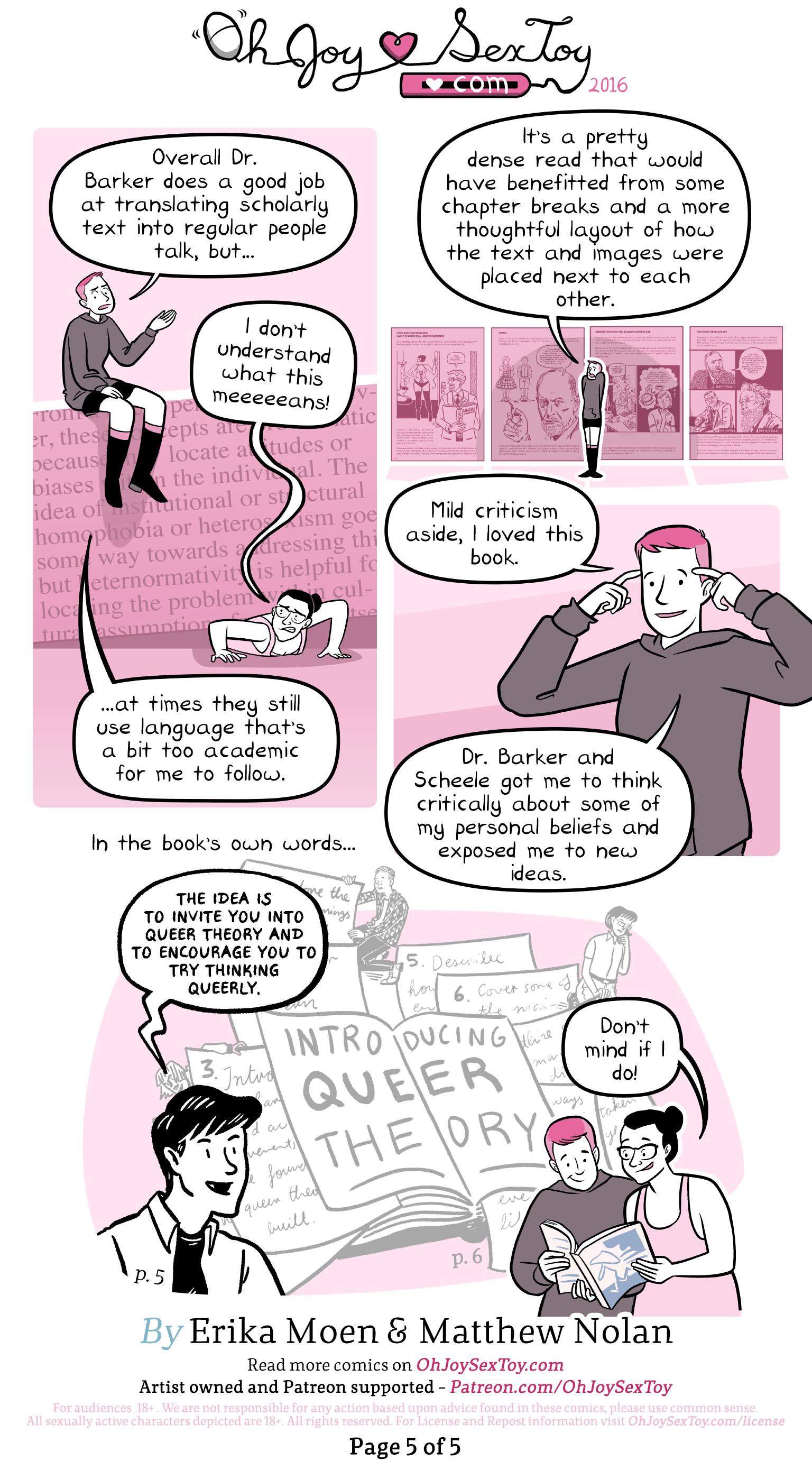
Page 5
"Overall Dr. Barker does a good job at translating scholarly text into regular people talk, but..." Erika says, sitting upon a wall made of tense text
"I don't understand what this meeeeeans!" Wails Alex, who is unfortunately getting crushed beneath the text wall.
Erika resumes, "...at times they still use language that's a bit too academic for me to follow."
Now Erika stands upright, getting squished on either side between densely illustrated pages of the book as she explains, "It's a pretty dense read that would have benefitted from some chapter breaks and a more thoughtful layout of how the text and images were placed next to each other."
Back to her normal size, Erika continues while pointing to her temples, "Mild criticism aside, I loved this book. Dr. Barker and Scheele got me to think critically about some of my personal beliefs and exposed me to new ideas."
Narration: In the book's own words...
Another illustration from Scheele fills up the bottom of the page. It shows an open book with lots of loose papers partially wedged between the pages with little people interacting with them. Across the open spread of the book, it reads, "Introducing Queer Theory". Another person stands closer to the viewer, explaining, "The idea is to invite you into queer theory and to encourage you to try thinking queerly."
Erika and Alex jointly hold open a regular sized book while Alex announces, "Don't mind if I do!"
Transcribed September 22, 2025 https://www.ohjoysextoy.com/queer-book
Erika draws in a soft, cartoon-y style with a pink palette. Samples of Julia Scheele's artwork appear throughout the comic as well, which are also cartoony but much more angular.
Alex wears glasses, a tank top and black leggings and stands outside a big black door labeled "QUEER". Their black hair is pulled back into a bun.
"Hm, you know I've always been curious..." Alex muses to themself. "Just what IS 'QUEER'?"
Just as they begin to crack the door, Erika bursts in from the side of the panel, shouting, "Wait! There's some things you should know before you open that do-"
Too late! Alex leans in to the room on the other side of the door, anchored only be their one hand on the doorway. They hold their free hand up to their eyes, to get a better look at the bedlam unfurling before them. It is a room packed with people all talking passionately and even arguing. Snippets of their conversations overlap, including:
"I was born this way!"
"Privilege!"
"Marriage is a civil right!"
"Gender is a performance!"
"Identity is fluid!"
"Marriage is a mainstream assimilation!"
"'Queer' is an umbrella term!"
"Why don't you make like a bisexual and NOT EXIST!"
"Intersectionality!"
"Sexuality is innate!"
"'Queer' is a SLUR!"
"We're all a little bit bi!"
Alex wheels back to the other side of the door, slamming it closed. "What was THAT?" They ask in shock as they slump against the door to keep it from re-opening.
"That, my friend, is the door to the world of everything "Queer" and all the concepts and discussions it harbors." Erika explains jovially. "...It can be a little overwhelming, I know." Erika is a white cis woman with short pink hair who wears a long hoody, black skirt, and tall black boots.
"Jeez Louise, everybody was talking about such different things and has such different ideas and, dang, where do you even START to understand this stuff?" Alex asks in confused frustration.
"Actually," Erika enthuses. "I've just finished reading a book that is the perfect map to guide you through these unfamiliar waters!"
Page 2
A giant copy of the book "QUEER: A Graphic History by Meg-John Barker and Julia Scheele. Published by Icon Books." appears next to Erika, who gestures at it, saying, "This invaluable book by Dr. Barker and illustrated by Scheele is a friendly introduction to the vast, deep, chaotic sea of (almost) everything 'Queer'. Ohmy gosh, I FILLED up my copy with notes on almost every page. It is required reading."
Information floats by the book, adding, "$17.95, 176 pages"
Reading from her own normal-sized copy of the book, Erika goes on, "The shifting ideas of sex, gender, and sexuality are looked at historically, culturally, lexicologically, biologically, psychologically, sexologically, and probably some other smart-sounding words that end in -ologically too."
Holding up their hands while taking a step back, Alex replies cautiously, "Whoah now, that sounds hella academic."
"That's the genius of Dr. Barker's book!" Erika continues. "It takes complex concepts and translates them into simpler explanations for the Average Joe like me who didn't major in them at a university or something. Basically, it's a crash course in queer history, philosophy, and activism."
Icons float overhead showing an hourglass (for history), the head silhouette of a person stroking their chin pensively with a thought balloon emanating above them (for philosophy), and the silhouette of a raised fist (for activism).
"Oo, and it's full of fun drawings!" Realizes Alex as they flip through the pages.
Page 3
"Ok, so if I read this, then I'll have a nice, simple cheat sheet to all the correct definitions and simple answers to my questions about queer stuff, yeah?" Asks Alex, holding up the book.
"Haha, that's not really how it works." Erika explains.
Narration: Something I really appreciate about Dr. Barker is how they emphasize that no definitions are "right" or set in stone.
A more realistic portrait of Dr. Meg-John Barker appears, showing them with a short crop of black hair, glasses, and a coat over their top shirt layers. They explain, "One key point of queer theory is that our understandings of sex, gender, identity (and pretty much everything) are contextual. That means they have all been understood, and practiced, in very different ways over time and across cultures." (p. 17)
Narration: Dr. Barker also devotes a lot of space to the contradictions, tension, and criticism of queer theory. They cover so many different perspectives and encourage you to figure out what concepts work best for you personally in your life.
A sample of Scheele's artwork is on display. It shows a person on either side of a diagonal line, representing their dual experiences. On the left side, they gesture at a blackboard with a pointer and are dressed professionally in a collared blouse with a long black skirt. This version of that person says, "My activism doesn't always agree with the theories I teach, but they often overlap." On the other side of the diagonal line, the same person is now dressed casually in jeans and t-shirt, holding up a picket sign with their other fist in the air.
Narration: Artist Scheele knocks it out of the park with her bold, deceptively-simple artwork. She's at her best when her drawings are literally illustrating the concepts Dr. Barker writes about.
Another Scheele illustration shows a black chalkboard with the words "RACE", "GENDER", and "SEXUALITY" written diagonally down it, while three hands paint over the black surface with broad white paintbrushes. "GENDER" and "SEXUALITY" sit on the section of the board that has been painted white, while "RACE" sits in the top left corner of what is still the blackboard, but is quickly being approached by the white paintbrushes.
Page 4
Erika walks down a hall of portraits, which are illustrated by Scheele. They include: Teresa de Lauretis, Michel Foucault, Julia Serano, Cathy Cohen, Gayle Rubin, Audre Lorde, E. Patrick Johnson.
She talks while gesturing with her copy of the book, "I have many large, embarrassing gaps in my education, and this book was my introduction to a lot of people and concepts that I vaguely recognized but never really studied. Honestly? I'd never even heard of a good number of the people and ideas in here at all. This book even introduced me to some ways of thinking and ideas that feel incredibly relevant to me RIGHT now, even outside of queer stuff!"
"Whoah, getta load of this Foucault guy and his panopticon theory!" Exclaims Alex in front of an excerpt from the book. It features another illustration by Scheele, showing three people standing back-to-back inside a rounded room of mirrors, each reflecting the person with some distortion. The person announces, "It's hard to be 'myself' when I feel like I'm being watched all the time." Overlaid across the illustration is an excerpt of text by Barker, reading, "Foucault, however, used the panopticon to illuminate the ways in which people in contemporary societies become so aware of the various critical gazes upon them that they end up self-monitoring their own actions through fear that they might not be acceptable to others. This has developed into a culture where everybody polices themselves through fear of punishment, ridicule, and disapproval." (p. 66)
Alex continues, "He wrote this in the '70s but he's describing me relationship with social media right now."
"I'm sure every 18-year-old college freshman philosophy student already knew about this, but it was new to me!" Chirps Erika, unashamed at her ignorance.
Page 5
"Overall Dr. Barker does a good job at translating scholarly text into regular people talk, but..." Erika says, sitting upon a wall made of tense text
"I don't understand what this meeeeeans!" Wails Alex, who is unfortunately getting crushed beneath the text wall.
Erika resumes, "...at times they still use language that's a bit too academic for me to follow."
Now Erika stands upright, getting squished on either side between densely illustrated pages of the book as she explains, "It's a pretty dense read that would have benefitted from some chapter breaks and a more thoughtful layout of how the text and images were placed next to each other."
Back to her normal size, Erika continues while pointing to her temples, "Mild criticism aside, I loved this book. Dr. Barker and Scheele got me to think critically about some of my personal beliefs and exposed me to new ideas."
Narration: In the book's own words...
Another illustration from Scheele fills up the bottom of the page. It shows an open book with lots of loose papers partially wedged between the pages with little people interacting with them. Across the open spread of the book, it reads, "Introducing Queer Theory". Another person stands closer to the viewer, explaining, "The idea is to invite you into queer theory and to encourage you to try thinking queerly."
Erika and Alex jointly hold open a regular sized book while Alex announces, "Don't mind if I do!"
Transcribed September 22, 2025 https://www.ohjoysextoy.com/queer-book